I went to the gym in the morning, and in the evening I decided to go out and explore the city.
I started the journey with the metro, but on the way back the weather was good.
I felt full of energy so I said “I’ll take the next station”, I walked to it and repeated the same thing.
I walked & I walked and basically never took the Metro. When I got back home I realized that I accidentally walked 25km and I wasn’t even tired.
This kinda blew my mind cause I think it’s the first time ever that I realized “walking infinitely” can be a thing. That I could walk non-stop without getting tired.
I had done hike-hikes where I walked for 8 hours, but all of that was in the “I’m hiking, I will push through tiredness and when I’m done I’m gonna rest bubble” but suddenly I discovered a new bubble of “not being tired”
Can You Walk 50km A Day Without Fatigue? My Experiment.
Fast forward to July 2026 and I decided to try an experiment. I wanted to see how much I could walk in a day without getting tired.
My definition of tired was very loose:
I don’t feel physically tired (there’s a difference between feet being “sore” and “physically tried”)
I lift weights like normal the day before and the day after.
So I had a normal heavy leg day on the 26th of July.
On the 27th, I left my place at 7am, I came back home at 7pm. End result? 47km
I was able to walk 47km in a day, and the points to note are:
Did the first 40km fasted with black coffee
On my second break instead of going for a coffee, I decided to stop at the gym and did a 30 min sled session
My feet started feeling sore at around 35km and my tiny pinkie toe started acting up a little at 40km which caused me to slow down.
I never actually felt tired in my body during this.
The next day, I was a bit slower in the morning but still hit the gym and worked out as normal but without the sled cause my feet were sore.
So, the only affect walking 50km was having to skip sled for one day. This blew my mind at how unaffected I was.
So, how did I get here? How long did this take? and how can stuff like this can be a “normal” for you too? These are basically the ideas I’d like to share in this article. [verdict] It’s possible to condition yourself to walk extreme distances with minimal fatigue. The following sections outline the strategy.
Addressing the Usual Excuses
As anyone who knows me knows, I don’t care about people’s bullshit
If you believe genetics is a cause for your problems, you probably should just leave this article here. If you think I’m in any way special and this is just a “jeremy thing”, leave my blog.
I’m going to assume that you are an adult that has atonomy to act and not a coward. So I’m not going to even mention “bullshits” I’m just gonna act like there don’t matter.
Periodic reminder (more for myself than for you) that I write for 0.1% outliers in optimism, thoughtfulness, creativity, kindness, competence, ambition, drive, curiosity. All are welcome to read and hang out, but I won’t dilute my writing trying to be “more accessible”.
This is something I often hear from “smarter” people. You probably have heard it often in your life.
Jeremy, that’s such a small change, why waste time thinking about that? Let’s talk about how the companies are making your fat, lets talk about the ‘big ideas’
No, you’re just being a lazy coward. Personally I don’t want to hear your view about longevity when you can’t sleep for 8 hours a day.
Now, it’s not just you. You’ll probably notice this sentence “it’s such a small thing” from the ‘smart but never done shit in their life’ people you know.
It’s them finding an excuse cause they don’t want to actually do the small things.
Toe Yoga, a weird exercise just for your toes, will improve your ability to walk long distances. So you just do toe yoga, a super small thing & you get the compounded results of those super small things.
Infinite energy is an end result of 100 small things. [verdict] Consistent, seemingly insignificant actions, compound over time to yield substantial results.
Ignoring Irrelevant Warnings: Focus on Empirical Data
When I got into fitness 10 years ago I remember all my family members used to give the excuse that “oh it’s cause you’re young”, wait until … you settle down… you get a job…you become 35 (which is now you become 25) there’s a reason Adult onset diabetics has a rebrand without the word Adult …
Let me tell you a simple reality, in the past 10 years not a single “Warning” “risk” I’ve been told by the so called “adults” in my life turned out to be true.
Obviously risks highlighted by “Real adults” aka the real experts like Peter Attia, Huberman, Domic D Augustine etc etc turned out to be useful. But not a single “warning” by anyone I knew before the age of 19 turned out to matter.
If a 50 year old tells you that you’ll walk less when you’re their age, ask them “did you ever walk 50km in a day when you were in your 20s”.
It’s hard to start a business in your 40s when you have a mortgage and kids.
Agreed, but then did you try it when you were in your 20s and had no debt. No? I guessed so.
Same with health: making any change is just gonna get harder with time. Start early, life just gets easier.
Cause here the thing, if you actually interact with a 50 year old that has, he’ll never be the one stupid enough to warn you about irrelevant risks.
Outlive (read the book) has a good section on this on how as you age your capacity diminishes. That’s obvious, so it’s all about what are you diminishing from.
If you can lift 200kg at 25 and you stick to fitness, by 50 you can still lift 50kg.
But if you can’t even lift 100kg at 25, by 50 your lived experience will believe that lifting 25kg isn’t possible.
Meet more 50-70 year olds who actually still climb mountains, you’ll learn to let of the wrong 50 year old’s opinions.
Basically: “do more” & meet more people that actually “do more”. People that “don’t do” don’t matter.
Note: This is kinda where it is good to know where you stand wrt information processing. For example, if someone highlights risks of something are you often in the position of “wow I didn’t think of that” or are you often in the position of “I’ve moved past that years ago/you accounted for the risks”.
For example I still get people ask me if this “work online and travel the world thing will last”, I just laugh and say “it’s lasted for 8 years, have you ever had a job lasted that long?”. Talking about the risks are useful with insiders, but rarely with outsiders & sadly most of the people in your life are outsiders in this bubble.
[verdict] Prioritize data and expert opinions over anecdotal warnings, especially from those lacking relevant experience.
Patience and Long-Term Perspective: It Takes Time
Be patient.
This might be the most important idea in this article.
It was only in 2020 that I ever succeeded at a doing 7 days water fast.
But I didn’t deny fasting being good for the 5 years I couldn’t do it.
Gotta break the self talk of “if I can’t do it there’s something wrong with me”
Because often it evolves to “no there’s nothing wrong with me, the facts are wrong”
Instead a better self talk is “xyz is good, I can’t do it yet and that’s fine :)”
Chill, give it years
I knew Yoga was very good in 2013, 2026 was the first year I ever did yoga everyday. Separate what is true from what you can do today.
Estimating: Between 2013-2021 I only did yoga maybe 10 times in 8 years.
I even said the sentence “people in the gym should do yoga, people doing yoga should go to the gym” in 2013. But for the next 8 years even I was just ‘talk’ wrt yoga.
But then finally in 2026, I’ve done yoga 200+ times. It took me 10 fucking years to make it a habit.
Give it years or even decades. [verdict] Success takes time. Adopt a long-term perspective and separate objective truth from current ability.
Starting Point Is Irrelevant: Focus on Progress
The most interesting thing about getting infinite energy in my mid-20s is the weird realization that I can’t actually say the sentence “i have the energy of a child” because I didn’t.
I remember growing up I was always the slow one. I wasn’t the slowest in all groups but I remember always being in the lowest 20 percentile of most groups.
Western excuse: “Indians are good with technology”
Eastern excuse: “Western people grew up hiking/have better genetics”
Cover story for cowardice & laziness in both cases
So where you start from matters little:
At the age of 18 I haven’t walked more than 30 mins in a row in my life.
At age 26 I walk more every year (3000km+) than most Scandinavians.
For some of you getting infinite energy will mean “wow I actually have the energy of 10 year old me” but for most people reading this it will be a “wow I didn’t know my body was capable of this.”
So, let’s begin [verdict] Initial fitness level is not a predictor of potential. Consistent effort trumps inherent advantages.
1. Prioritize Fat Loss Through Sugar Elimination
I had the following conversation with a friend recently:
Me: I eat more to gain fat when I see 8 abs, and I start to lose fat when I only see 4 abs.
He: I haven’t seen my abs since I was 16
Me: Yeah because of sugar and ultra processed carbs.
He: But we allate sugar
Me: No, no we didn’t. I quit sugar nearly 10 years ago. Don’t use the “we all” bullshit with me.
Receipts: I’m not making bullshit up for clout
It’s crazy for me to think about but it’s nearly 10 years since I quit sugar.
Will it be hard for you? Yup of <a href="https://jeremynoronha.com/how-to-set-up-a-course-website/”>course. You can come off with all the reasons why it’s a small thing, or you can just do the obvious
Quit sugar (translation): You know the obvious (10-minutes-on-google) reality that sugar is posion so you stop eating anything that’s made with sugar. You also know that after you quit things with sugar after 6-12 months your body completely stop craving it and you don’t have to intentionally avoid it. Drinking cocacola becomes a 1-2 times a year thing if at all. You have 0 things with sugar in your house.
Sugar = Ultra processed foods, junk food, literally white sugar, liquid calories etc.
Key point above: longer you’ve been in the above bubble the more easy life is. You don’t need to actively aviod anything because your body genuinly doesn’t crave it anymore.
Obviously you still try new deserts when you travel etc.
Note: after you’ve been off sugar for a long time, you don’t even get craving if you eat. I can eat 2 donuts in a single day and then go months without sugar without ever getting craving.
Now if you understand the obvious realities of shit vs not shit food, second step is actually act on it.
It all comes down to 3 things: Will power, habit & confidence
Will power: resist snacks, resist junk. Meditate more, less social media, less internet, less alcohol, more nature.
Habits: No snacks or junk in house, intermediate fasting if you want to lose fat, stop ever having ‘snacks’ switch to “meals”, no liquid calories.
Confidence: When I was around 14 I told my mom I’m gonna start cooking for myself. I tried and very quickly realized I wasn’t gonna be able to convince them of obvious things, so I decided to just optimize my life. Once in a while I would eat the same things they would but most often I started changing the way I ate such that I started cooking more and more of my own meals.
If 14 year old me was able to tell my parents “you are wrong”, some of you really need to up your confidence if you are too afriad to the same to you friend and parents today.
The world isn’t going to get healthier, before talking about world nutrition fix your own plate.
Most of these things come down to obvious realities like “alcohol is 100% bad”
The above statement is 100% true. Now, that doesn’t mean you can’t drink. But for fucks sake don’t be stupid and come up with some bullshit theory why it’s good.
Esoteric longevity tip you won’t hear about from Bryan Johnson:
Go out to dinner with your friends and family. Order a bunch of delicious food. Drink a bunch of wine. Stay up late telling stories and laughing.
Live life! Alcohol = 100% bad, while “life with alcohol once in a while” = good.
Key point: you don’t need to bullshit people around you or worse, yourself.
Once you fix the obvious food habits in your life, losing fat will be an obvious thing. It becomes a dial that you can control.
I recommend most guys getting down to where they can see a 6 pack and then staying there (don’t bulk) for at least a year, most people have no idea how light it feels to be at 10-15% body fat. “Low fat is dangerous” – only below 5% for guys, being at 5-10 is normal.
Also, 10% body fat usually = 6 pack. You’re probably carrying more fat than you think. What you call “20% fat” is usually “30+%”.
Women should probably be around 20-25% (if you can measure), but you’ll probably know.
Guys: While #2 point is “gain muscle” and yes bulking helps in gaining muscle. I actually don’t think you should even go close to bulk until you’ve first spent nearly a year being lean enough that you can see a 6 pack on a good day.
Even without the gym for like 6 years, just traveling around I never got fat enough that I couldn’t see 4-6 abs all the time. Fat is completely about food (not gym) so sort your nutrition out. [verdict] Eliminate sugar and processed foods to achieve and maintain a body fat percentage that allows you to see a 6-pack. Aim for 10-15% body fat for men, 20-25% for women.
2. Gradually Increase Muscle Mass
So, step 1: Get lean
Step 2: Get overweight
What?
Okay, well maybe not entirely overweight but at the border.
A joke might explain this better
If you have to tell people that BMI is inaccurate, it’s probably very accurate for you.
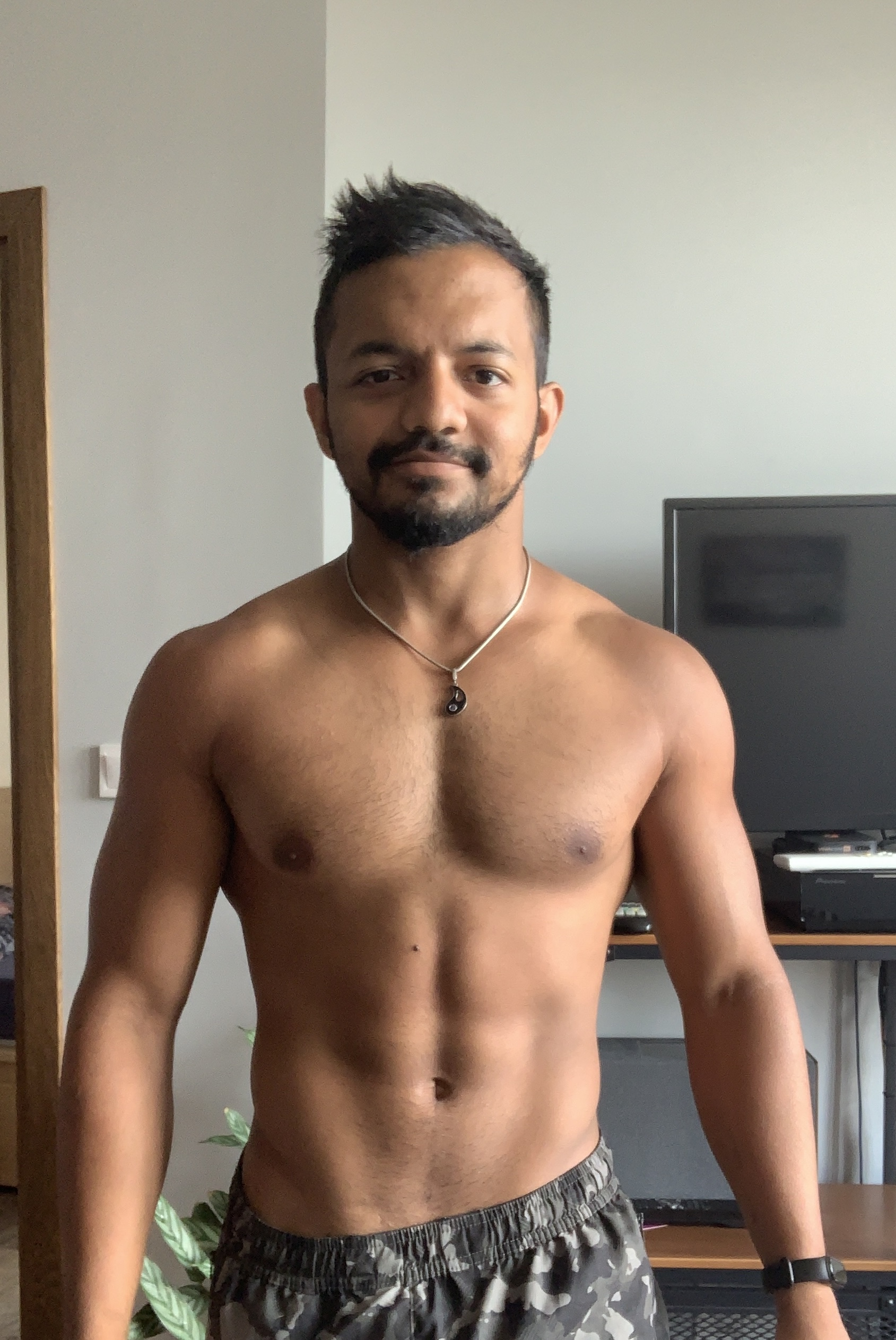
As of a few weeks ago according to my BMI I’m officially overweight for the first time in my life. Here how I look today:
Step 2 is gain muscle (gradually) such that you are on the borderline of normal/overweight while still not carrying about fat.
I write below of 4 pillars of fitness & how to never plateau.
Gradually: Good heuristic is 1kg of muscle ever 2 months. Zoom out and only focus on the yearly change.
Note: The “overweight” applies more to younger people <40 year. But the “more muscle” is true for everyone.
Now due to height, the taller you are the less close to overweight you will be probably. But the key point being get lean and then also gain muscle.
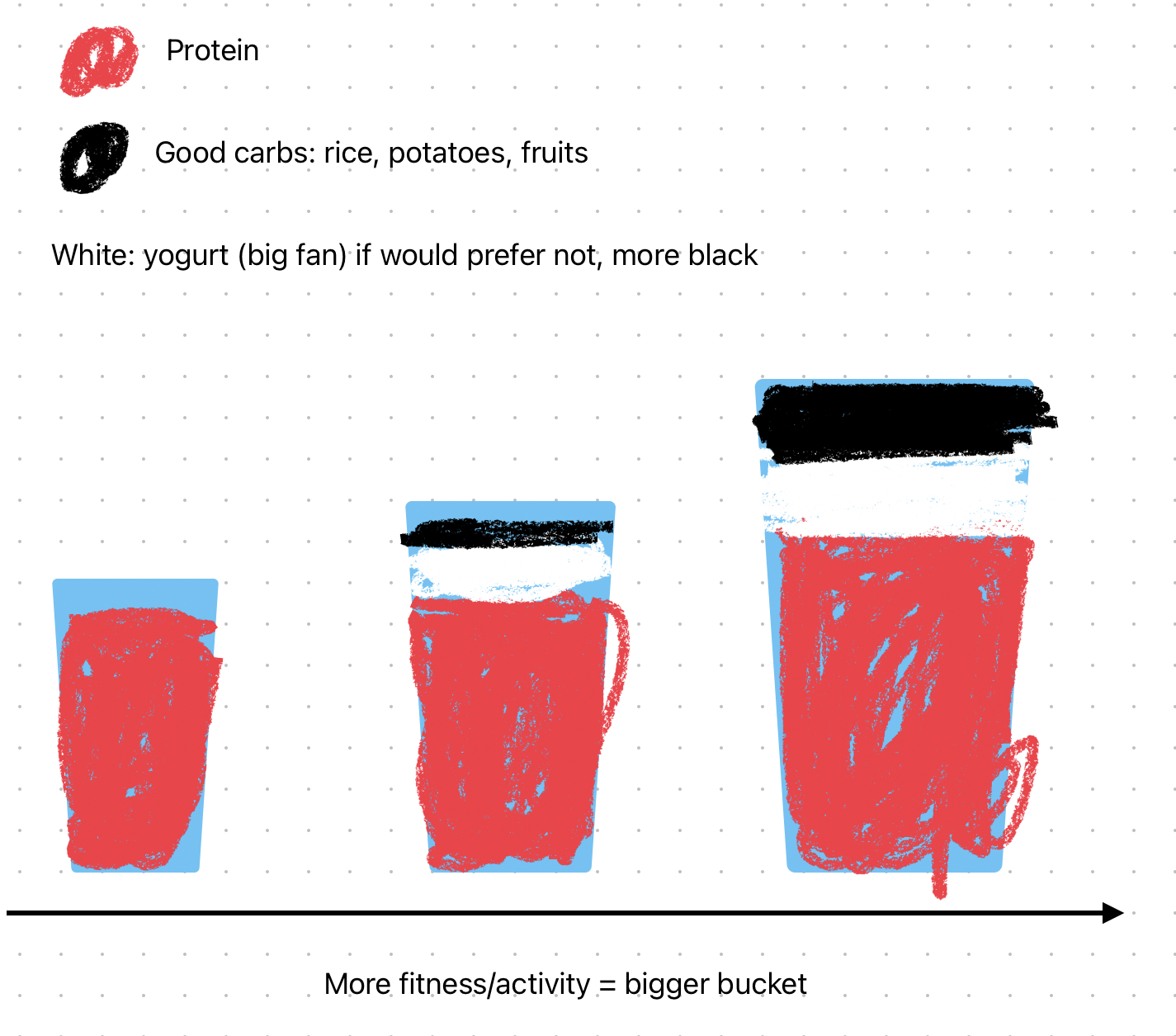
Gain muscle is actually a cheat when it comes to nutrition:
The more muscle you have the more calories you burn naturally = you can eat more food overall
The more muscle you have the more insulin your body absorbs = you can eat more carbs without downsides
The more muscle you have the more strength you can have
A good hurestic I use of diets is |less muscle: Carnivorne -> high protein lazy Keto -> lazy Keto with lots of dairy -> medium carb : More muscle|
Lazy keto: keto is more about high protein and less about the high fat. It’s more about reducing carbs. In this bubble intermidiate fasting is probably a thing that works great for some too.
Vegan: Mostly vegans are unhealthy vegans but it’s possible to be a healthy vegan Rich Roll has some great content on it. Same with religious Indians etc. Find the top quality content for your specific life.
Now, if you waste time with strawman’s you’ll focus on the downsides of muscle when reality is you don’t need to deal with them.
1. Flexibility: You should start doing yoga as soon as you go to the gym. By year 2-3 of going to the gym, you should probably be doing yoga more often then going to the gym. Yoga sessions should get longer such that it’s min-30 mins
2. Not functional: #3 will be around using your muscles, but if you ever have to pick “do I go on the 10 day hike or continue my gym routine” you always pick the hike/adventure. Using your muscles in a sport, on an adventure means you never actually get the “fake gym muscles” and instead you always end up using them.
Making fun of stiff bodybuilders means jack-shit unless you are as muscular while being more flexible than the yoga teacher. – Don’t laugh, just optimize reality
A way to describe the reddit is you can either have the most upvoted comment, or you can have the result in life. Never both.
Similarly, you can either laugh at stiff bodybuilders, or you can get muscular & flexible, ignoring both subgroups.
[verdict] After achieving leanness, focus on gradual muscle gain (approximately 1kg every 2 months). Prioritize flexibility and functional strength alongside muscle hypertrophy.
3. Integrate Adventure and Sports into Your Routine
I use the word adventure because for most people that’s what it is. I include all sports in this.
Start doing multi day hikes, if you never done it then just pick whatever and do it.
Pick a new sport and just get very good at it.
I wrote about doing the Annapurna circuit hike in 2016, I didn’t have infinite energy back then.
In fact, half of you reading this have more energy today then I did when I did that hike. Until I did that hike I never walked more than 30 minutes. Yet I did a 250km hike.
Doing shit like a above means you let go of bullshit excuses you tell youself and maybe start optimizing more around reality and less around the opinions of other.
You’re obviously capable of 10x more than what you think is “hard”
Your gym & yoga results will help you in your sport or your adventure. But always pick the sport over the gym if you can.
Hopefully as time goes on, you get more energy as well as more free time so you can do more of them at the same time. [verdict] Prioritize real-world application of your fitness through sports and adventure activities. These activities provide functional strength and mental resilience.
4. Layer Fitness Pillars: Strength, Stability, Zone 2, VO2 Max
Peter Attia has a very good video on the 4 pillars of Fitness
Strength
Stability
Zone 2
Vo2 Max
Now, you can watch the video & read his book to understand it. You might even have different pillars in your life.
Each one of these bubbles help you in different ways. It’s not Gym vs Pilates it’s Gym & Pilates. ALWAYS
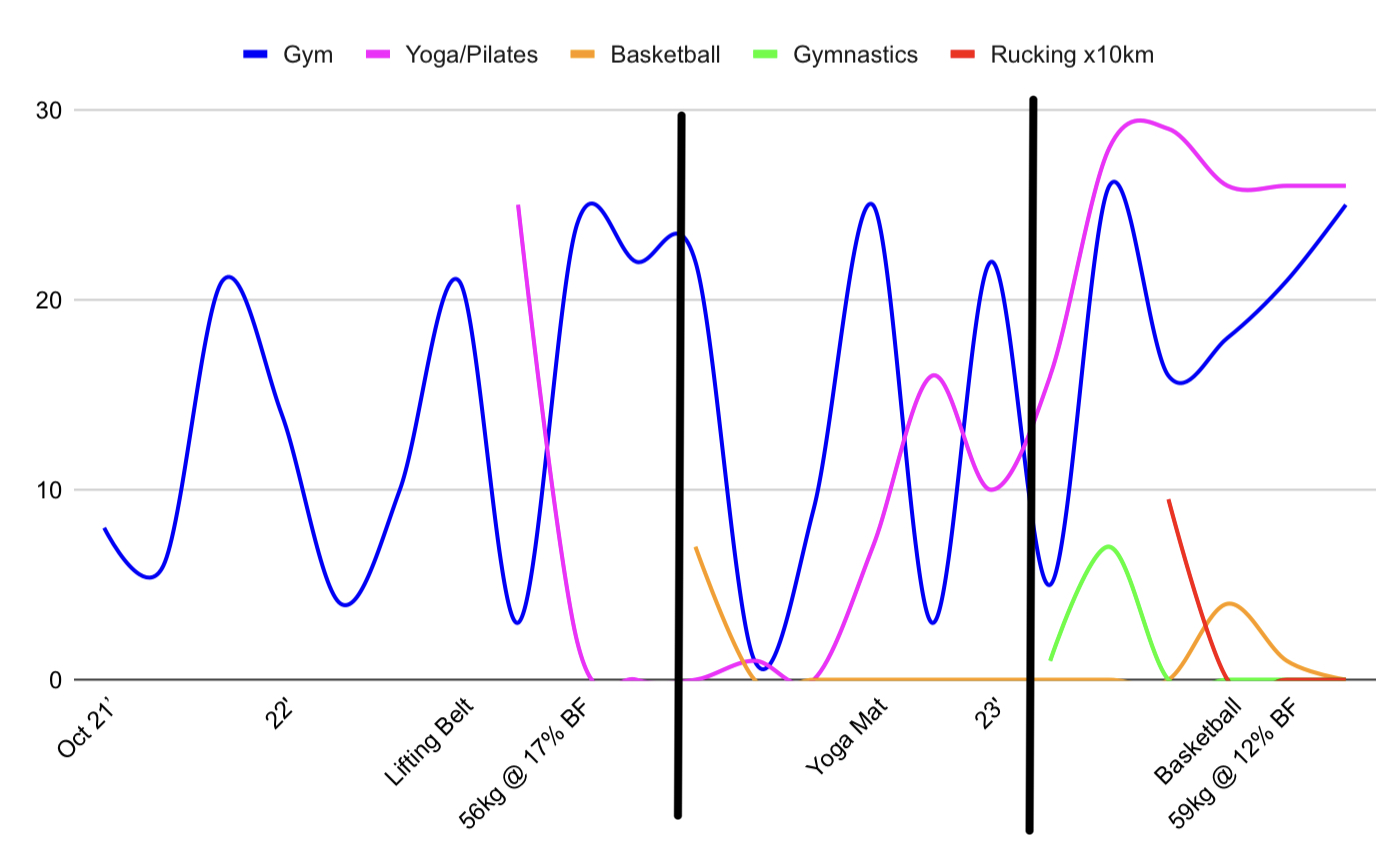
Here’s the graph of the 5 bubbles I’m personally trying to focus on:
I drew the Black lines for a very specific reason:
Oct 21 – Mid-22: I only ever had energy for 1 thing at a time. I had to pick between Gym or Yoga, I didn’t have the energy to do both, so it was either I’m doing yoga this month or gym this month.
Mid 22-Start 23: I started adding 2 things at a time. I could go to the gym in the morning and then go play basketabll in the evening.
Start 23 onwards: 3 things at the time. Adding yoga every morning increased recovery, so Yoga went from “taking energy” aka GYM or YOGA. To “Giving energy” yoga helps me recover from gym + basketball etc.
So the 4 pillars for me as of right now:
Strength: Gym (Habit since end 2021)
Stability: Yoga & Pilates (Habit since end 2022)
Zone 2: No habits yet (Rucking, Swimming)
Vo2 Max: No habits yet (basketball, surfing)
Layer on things slowly, don’t fomo and crash, sustain. Think in terms of habits. [verdict] Layer fitness modalities (strength, stability, Zone 2 cardio, VO2 max) to create synergistic effects. Consistency is paramount.
5. Prioritize Daily Walking (Outside of Structured Exercise)
This next sentence is going to annoy some of you.
Walking doesn’t count as exercise. It’s walking.
You should probably walk more, a lot more. A fitness tracker might even be a good idea so you can get an idea of what you currenty walk.
I went through 4 stages with walking the past decade:
Pre travel: Never walked more than 30 mins in my life growing up in Goa. (Approx: always less than 100km/mo)
Travel: Explore mode = gradually walk more (100km+ a month)
Hiked more often: When I started getting into hiking I started walking more, but at the same time I got more lazy when I wasn’t hiking. So it was all or nothing. (150-200km+ a month)
Today (after covid crash): Always taking the stairs, always walking if the weather is good, going rucking after leg day etc etc. (300km/month)
The reason I highlight the above is because it took me 8 years to go from stage 1 to stage 4. Start creating good habits but also be patient.
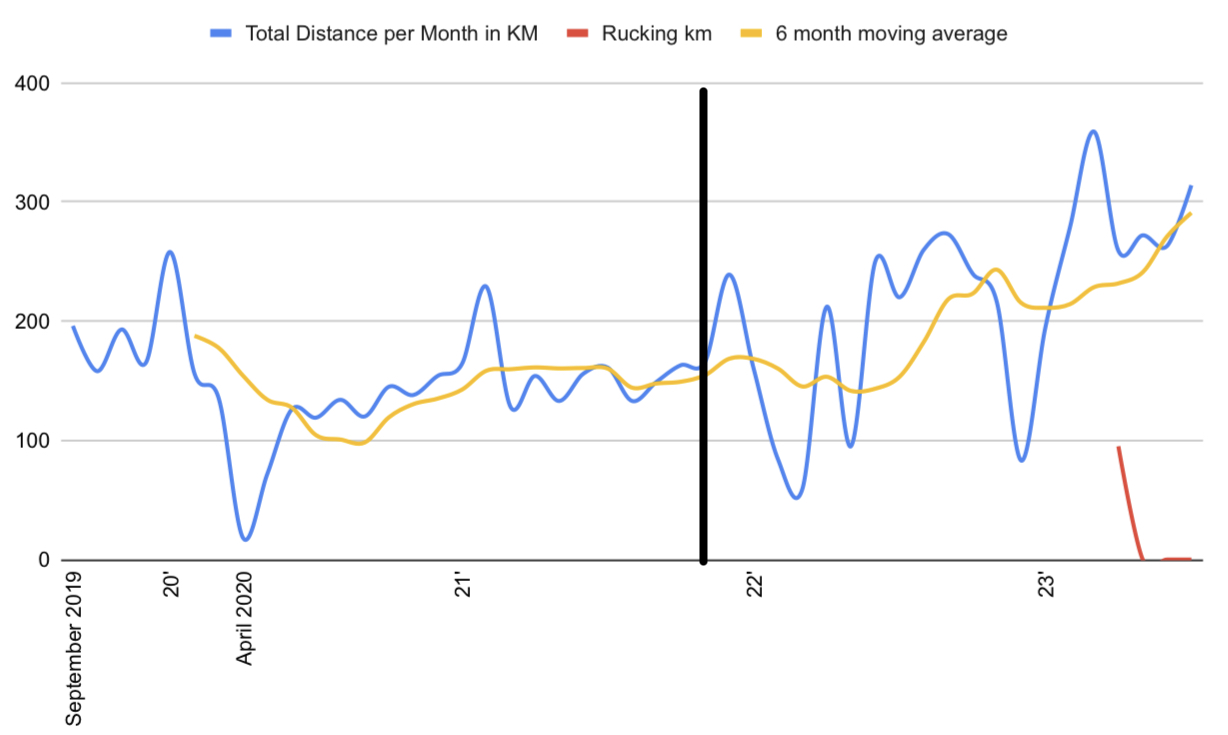
I have my walking data since Mid 2019 and I think it’s very useful and some of you will find it interesting.
Black line: Joined gym again in 2021.
The reason this chart is fasinating is you can see the effect covid had even on someone active like me.
6 month moving average (yellow line)
Pre covid: 200km/month
Worst Covid: 100km/month
Year after Worst covid: 150km/month
I joined the gym and got a fitness tracker and so many other things to kick myself out of the lethagic couch mood I was in after covid. I lost like 25% of my normal walking energy after the entire pandemic and everything that came along with it.
Just cause browsing twitter every week was useful in January 2020, doesn’t mean I should be on it in 2025.
Anyways, after making all these changes as well as always prioritizing walking I now have a moving 6 month average of 300km/month.
I not only got over my lethagic covid crash but I was able to use the gym to go furthur then pre covid
Part of this is also not having the stupid discussion of “Nature is better than a gym”. Just do both, lifting weights will make walking in nature easier and vice versa.
Never met anyone who said “Hiking is better than a gym” who hikes more than me. Maybe stop making false dichotomies.
Note: I don’t walk on a threadmill. Also, yes it is easier to walk in some places vs others, but it’s also you. For example in November 2022 I walked 220km and I was in fucking Delhi for the whole month. Delhi and 220km/month was normal. Obv things are easier in places, but have the willpower to do the hard things instead of complaining [verdict] Walking should be a daily habit, separate from structured exercise. Aim for a minimum of 300km per month. Track your progress and adapt to your environment.
6. Implement Progressive Overload in Strength Training
This is specifically to the gym and important enough that it needs it’s own section.
Year 1: Just showing up in the gym every week is the most important part. Your body is not used to exercising so whatever you do will help. Don’t overthink, just show up. Don’t focus on optimal or effectiveness, it doesn’t matter. Compound movements are your best friend. Read the rest of this section in year 2 of the gym.
Year 2: Once you’ve been lifting for a while, start being more effective in how you train.
Year 2+ Aka how to never plateau
IMO there’s 4 different focuses you can have in the gym when it comes to progress.
Volume
Heavy
Intensity
Effectiveness
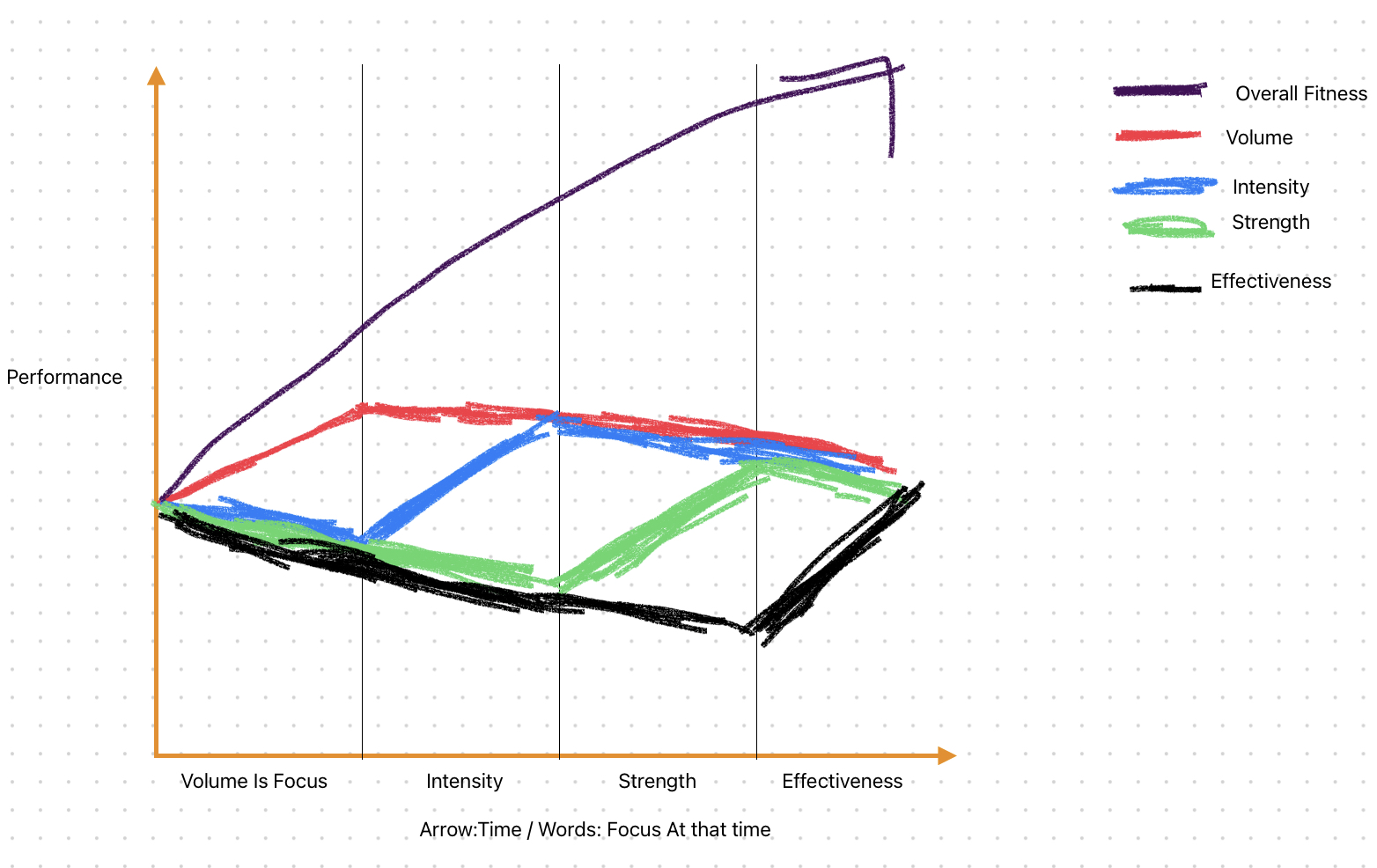
I genuinely believe you get the most value by only focusing at 1 at a time.
Now, it doesn’t mean that your other bubbles get bad. No instead you let the other bubbles plateau while you improve on the focus.
Here’s an image to explain:
An example:
Between December 2021-Jun 23 strength was my focus (off/on): During that time I went from deadlifting 100kg to 165kg.
The next year I stop focusing on strength: Today while I’ve been busy focusing on Volume, Intensity and now Effectiveness, my deadlift is 1RM is 140kg.
While I stop working on it, It doesn’t collapse back to 100kg, no it plateaus at -5-10% while I 10x other bubbles.
The bubbles explained:
Strength: Here it’s a focus on improve your 1RM, you probably train in the 3-8 rep range here. Think powerlifting training.
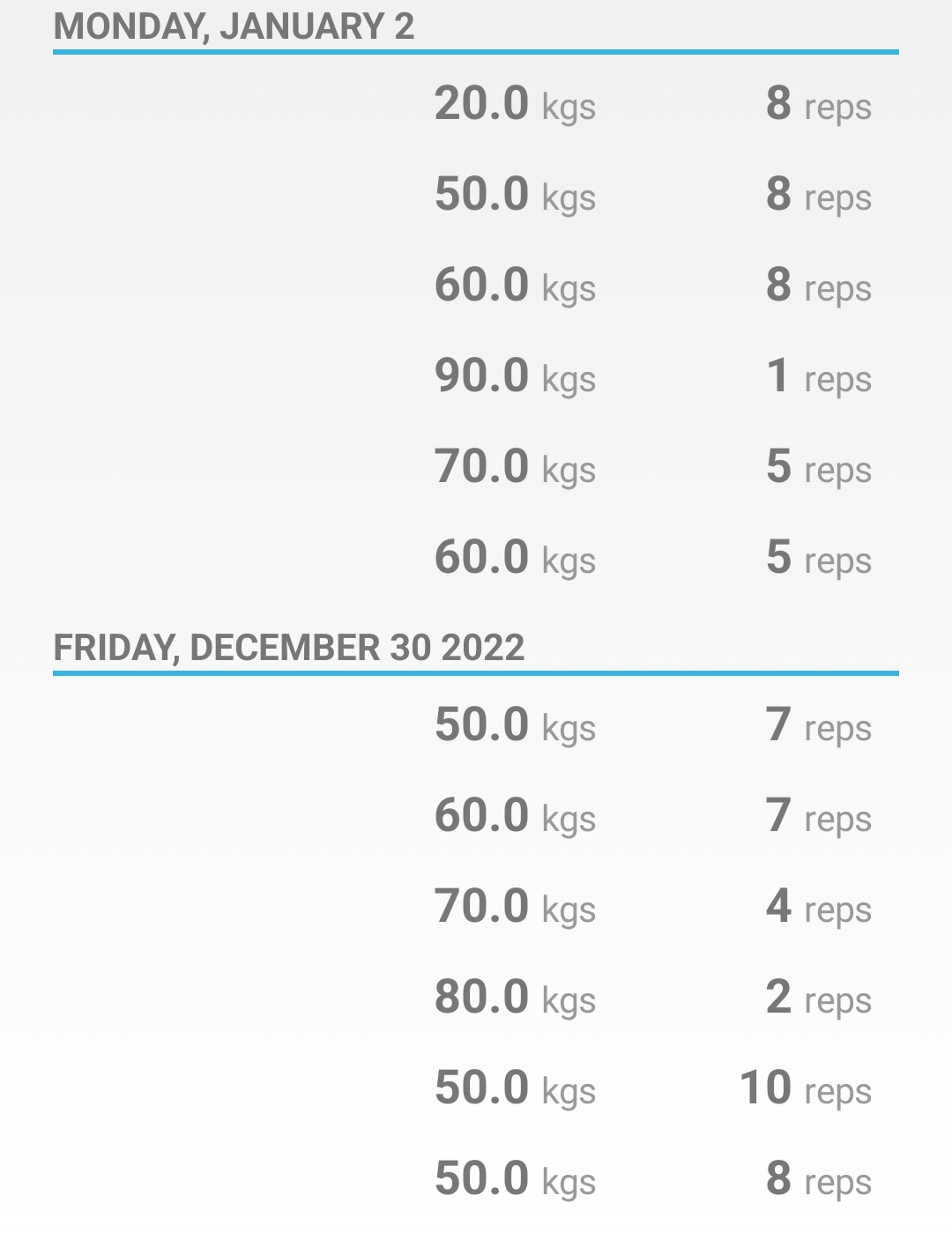
Volume: Volume is basically weightrepssets. eg. 100kg10reps3 sets= 3000kg of volume. For volume being focus it’s good to use a gym log app (I use fitnotes). Here’s an example of how my Barbell squats were unstructured vs with structure.
Hey! I’m Jeremy Noronha and I’m a online marketer and full time traveler.
I’ve been living out of a single backpack traveling the world since early 2016. I used to work as Technical SEO Consultant (Former Head of SEO at Foundr.com) and travel blogger.
I now blog on JeremyNoronha.com writing about whatever is on my mind 😁



Leave a Reply